In user tests, I’ve noticed that people who have difficulties with reading or understanding information often react quickly and strongly to subtle interface issues. The way they approach a page can highlight needs that are less obvious with other users. It made me wonder whether designing with their needs as a baseline could lead to more accessible services for everyone, without creating barriers for anyone else.
To better understand this, I spoke with Paul Seta, who has Developmental Language Disorder (DLD). This condition affects his memory, communication and understanding. Like many people with dyslexia, DLD or other neurodevelopmental differences, Paul experiences more than one dys‑related difficulty, which shapes the way he learns, works and interacts with the world.
Having trained in digital accessibility auditing, Paul works in a field where analysis, attention to detail and reporting are central. I was curious to understand how he navigates a profession where analysis, accuracy and reporting are central, even though processing information can require a great deal of effort for him.
Paul talked to me about training in accessibility within a company that employs and supports disabled workers, after years of misunderstanding at school. He explained how his learning difficulties affect his daily life and the strategies he has developed to keep learning.
He also shared how generative AI tools help him overcome some of these challenges, and how this has changed the way he approaches work and interacts with others.
Finally, we discussed perceptions of disability, the misconceptions that still persist, and what he wishes people better understood about those who, like him, experience the world differently.
This interview was conducted in French and then translated to British English.
Working as a digital accessibility auditor with Developmental Language Disorder
How did you first discover digital accessibility?
When I was at school, teachers didn't really understand this kind of disability. They only thought about people who use wheelchairs or other visible disabilities. So I've always told myself, maybe a bit naively, that I wanted to help raise awareness of what disability actually is.
Even in large companies, people don't understand cognitive disabilities.
I work differently. That's part of who I am, and it needs to be taken into account. I'm not any less intelligent than anyone else.
It's quite frustrating not to be able to talk about it openly or help move the conversation forward.
What is a supported employment company?
In France, a supported employment company employs at least 55% disabled workers. There is a partnership between Numerik-ea, where I trained, and Temesis, which is part of the same group, Ctrl-a.
For each audit, I was able to speak with an accessibility expert from Temesis once a week, whether about the website I was auditing or accessibility more generally.
It's really exciting because I'm learning a huge amount. Most importantly, I genuinely feel useful and my disability is part of that.
In what ways does your disability help you as an accessibility auditor?
I'm quite a curious person. I enjoy learning new things. So when I start an audit, I first look at what's already there and take some time to explore the website.
Because of my disability, information needs to be fairly clear. Otherwise, I can quickly lose track. When there are lots of instructions, text or information to process, I get overwhelmed quite easily.
Simply trying to understand the purpose of a website already tells me a lot. If I start to feel overloaded during that process, particularly because of my memory difficulties, it can be an indication that the website may have readability or comprehension issues.
How do you feel about presenting audit results?
I really enjoy presenting audit results. However, from those I've taken part in, I've noticed that many people struggle to understand the value of what we do.
Most of the attention tends to focus on the compliance score, which is seen as a requirement, or on comparisons with competitors, rather than on analysing the findings and implementing corrective actions.
Can DLD be a source of anxiety at work?
Yes. For example, during one of my recent audits, there were five or six long email exchanges between the client and my colleague. I found it difficult to process that much information at once, and I was anxious about forgetting important details.
I always have to stay alert.
Can that constant state of alertness ever be an advantage?
Yes, because I have to compensate for my disability, I'm always alert, seven days a week.
I'm always thinking about it, and I really enjoy it. Even at weekends, I watch short interviews and keep learning. It gives me a bit of an advantage.
It can be difficult for me to take part in conversations.
DLD, everyday challenges and digital strategies
Could you tell me about your DLD?
So, I have Developmental Language Disorder (DLD). From the age of four, I spent ten years working with a speech and language therapist.
It’s a disability very few people have heard of. Most people are more familiar with dyslexia, which is often used as a bit of a catch-all term.
DLD affects memory. For example, if I have to learn a text, such as a poem, I'll struggle.
It affects both long-term memory, which is the ability to remember things over time, and working memory, which is used to process information I've just heard or read. I sometimes struggle to find the right words, and it can affect verbal thinking and conceptualisation.
I'm talking about DLD, but dys‑related difficulties often overlap. For example, dyscalculia or difficulties with spelling and written language. In my case, I've never managed to memorise times tables!
When I had to learn the RGAA (Référentiel Général d'Amélioration de l'Accessibilité) which is the French version of the Web Content Accessibility Guidelines (WCAG), it took me much longer than everyone else. It took me about four to five months to learn all 106 criteria, whereas other people learned them in about a month.
I needed more time to really understand how everything worked. And even once I understood it, I had to keep practising regularly. Otherwise, after six months, I would have forgotten it all.
What challenges does DLD create in your daily life?
It might not seem obvious when you meet me. We can have a good conversation and everything feels quite natural. But writing emails or text messages is much more difficult for me.
I had a lot of difficulty learning to speak, write, tie my shoelaces and do other basic everyday things. People usually don't realise, but I've struggled with French all my life, even though it's my native language.
And foreign languages are even harder. For me, they're simply impossible.
French already feels like a foreign language to me. To my great frustration, English is impossible for me. That's something I find quite frustrating, actually. If you want to learn about cybersecurity, most of the documentation is in English. It's a subject I'm really interested in, but I just can't access it.
It was the same when I became interested in websites as a teenager. I struggled with HTML and CSS because everything was in English. So I turned to CMS like WordPress. You can build things using components that are already there. At the time, I didn't know anything about accessibility of course.
More recently, I was also diagnosed with a permanent auditory processing disorder (APD). This affects the way verbal information is processed and makes it difficult to filter sounds and separate speech from background noise.
As a result, I become tired very quickly in noisy environments. It's disabling, and it's difficult for people to understand because I seem to react to noise in the same way as everyone else.
How does your disability affect your social life?
When I'm with friends or in a meeting and everyone is talking at the same time, I struggle.
Even though my hearing is normal, the way my brain processes and interprets sounds is a real challenge. I have to concentrate to understand what's being said and not confuse similar-sounding words. After a while, I become mentally exhausted.
Because of that, it can be difficult for me to take part in conversations, which can sometimes create frustration on both sides.
It's different from this interview, where it's just the two of us. I can follow the conversation, understand your questions and respond to them. The exchange feels quite natural, I think.
However, when there are lots of people and background noise, it's impossible for me.
I had the same issue when I first started my accessibility training. At first, I was the only person who didn't speak. Everyone thought I wanted to give up or that I wasn't interested.
But that wasn't the case at all. There was simply too much noise, and I couldn't follow what was going on anymore.
Do you watch films or TV series?
Not very often.
I tend to feel like I'm wasting my time. If I watch a film and you ask me afterwards what it was about, I probably wouldn't be able to tell you. I just wouldn't remember.
And the ultimate challenge is when a film is in the original language with French subtitles. After ten minutes, I'm completely lost.
It's the same with books. If I want to remember what I've read, I need to read it four times.
What’s the best way for people to communicate with you?
Because of my invisible disabilities, it helps when people speak slowly and avoid background noise or other distracting sounds.
What's unfortunate is that, even when I explain this, there's still often some frustration. Sometimes for me, sometimes for the other person.
Over time, I've ended up losing quite a few relationships because of it.
I hope that by answering your questions, I can help other people. I'm very happy to do it.
Has DLD affected the way you perceive time?
Yes, it can affect the way you organise events in time and how you perceive time itself.
When I was a child, every day was Monday. Because I was at school, and I hated it.
You'd think I would have preferred every day to be Saturday!
And if you asked me what time it was, it was always 10 o'clock. I was stuck on Monday at 10 a.m. all the time.
Then, when I became a teenager, something changed and I started to perceive days and time normally.
If I didn't have ChatGPT, it would take me much longer to reply.
Compensating for DLD: memory, organisation and cognitive load
To what extent can dys‑related difficulties be compensated for?
At first, the goal of speech and language therapy was to help me tell similar sounds apart, learn to read and write, and develop the skills needed to keep up at school.
When I was in secondary school, I was bullied. The problem was that it took me a long time to realise what was happening. I struggled to understand people's real intentions.
Nobody comes up to you and says, "I'm bullying you." Sarcasm is something I've always found difficult to understand.
Without speech and language therapy, I would even have struggled to have the conversation we're having right now. It probably wouldn't have made much sense to you.
Even now, if I don't get eight hours of sleep, the next day is a disaster. I need to keep a routine and look after myself.
What coping strategies have you put in place?
I've had to become very organised, otherwise I'd forget everything.
It was difficult and frustrating, especially at work. It can also be a problem in everyday life, particularly when I'm on my own.
I need to remember to eat for instance. That's a bit sad to admit, but at least that only affects me. The thing is, I also have two cats. I need to think about them too, and that's important!
So I have my little checklist, my reminders, and I try to be as organised as possible. I also use calendar alerts on my phone for birthdays.
When it comes to messages, I try to reply straight away. Otherwise, I'll never reply at all. I still have New Year messages from the beginning of January that I never replied to. Because it involves writing, I find it difficult.
Assistive technologies and generative AI
Do you use text-to-speech to help with reading difficulties?
No, because memory is the main difficulty.
If you send me a voice message that's 30 or 45 seconds long, that's fine. But if it's three minutes long, I won't remember what was said at the beginning.
I remember that during training, some concepts were very abstract. Eight-hour days were exhausting for me.
Things need to be explained clearly. Decorative images, for example. What are they? They're this, and that's it. No need to make it more complicated.
The ‘Scripts’ section of the RGAA is a difficult one. One day, I was talking about it with an accessibility expert. She asked me, "Which criterion are you struggling with?"
I said, "Criterion 7.3."
She replied, "Right, for criterion 7.3, just remember this: if you can't tab through a submenu, it's 7.3."
It took about fifteen seconds, and that was it. She then showed me several websites where this issue occurred.
When there's too much information, I get completely lost. Everything starts going in different directions.
In fact, I've forgotten what we were talking about now.
Does generative AI help you compensate for DLD?
Oh yes, absolutely.
I use ChatGPT to write emails and text messages. I ask my questions using voice, and it suggests a reply for me.
I use voice because, if I had to type what I wanted to say, the AI probably wouldn't understand me.
So yes, I've become a bit dependent on these tools.
Did you need generative AI to respond to my interview request?
Your text message was quite long, so I had to read it in stages. I also read it several times.
But Jonathan Pansiot had already told me that you were going to contact me. So I immediately understood who you were and why you were writing to me.
In situations like that, I take the time to break the message down into smaller parts.
I think I replied to your message quite well. I tried to structure my response clearly.
The downside is that it can hide my disability and make people think I don't have one.
If I didn't have ChatGPT, it would take me much longer to reply. My message would be less clear, and it would probably contain spelling and grammar mistakes.
Hang on, what was the question again?
Designing for people with DLD
Are you able to manage administrative tasks on your own?
Yes, absolutely. In fact, I enjoy doing them. Sounds strange, doesn't it? It doesn't cause me any problems.
If I need a home insurance quote, I'll look up how it works online, and that's absolutely fine. I actually enjoy doing it.
As soon as I turned 18, I filled in the paperwork to enroll at a driving school.
I won't pretend the theory test was easy, though. I was actually quite nervous about it. But I developed my own method and made sure I studied every single day.
In the end, my instructor told me I was one of the best students he'd had in the past ten years. The driving test only lasted for twelve minutes. He said, "Perfect. You drive as if you've been doing it for ten years."
What he didn't know was that I'd needed 51 hours of driving lessons before I was ready for the test. It cost me a fortune and took me nearly two years.
What can make a website difficult for you to use?
I need to understand straight away what the website is about and what I'm expected to do.
If I need to make an insurance claim, for example, the process needs to be broken down into clear steps.
I don't want a form with thousands of things appearing all at once. If there are fifteen fields to complete, it's better if they're revealed progressively.
If there's too much text, it's going to be a disaster. I'll miss things.
Everything needs to be clearly broken up: First name, surname. Then the claim. Then the date of the incident, the cause, and so on.
It might take me longer, but that's better this way. I can't deal with too many instructions at once.
It also helps if my progress is saved automatically as I go along. I'm likely to take a two-minute break and come back later. I'll go out onto the balcony, get some fresh air, and then return. So I don't want to lose everything each time.
Questions need to be specific. If they're too vague, I'll keep going back to check that I've understood correctly.
And there needs to be enough spacing between sections of text. That's important.
If I could do just one thing as a UX designer for you, what would it be?
There should be examples and images to help explain things.
And above all, no page refreshes or timeouts that cause me to lose what I’ve entered.
Another thing that could help is having a comment box at the end of a form where I can add anything I may have forgotten.
A bit like when you do your taxes, they ask you whether you may have made a mistake in the form. That can be really useful.
Disability, supported employment and the pursuit of equity
What can disabled people bring to the design of digital services?
Disabled people often need digital services to be simpler and easier to use.
By designing around our needs, you can also meet the needs of other people, including those who aren't disabled. For example, if an older person is just starting to use digital technology, it's better if things are kept simple.
To give one example, some banks have redesigned their apps with simpler journeys, less information on screen and more guided steps.
As a result, there are fewer mistakes for everyone, not just for people with cognitive disabilities.
I also appreciate it when people ask questions and take an interest. It's helpful for people who aren't disabled as well, because working with us helps them understand these issues better.
In fact, if more disabled people were involved in designing digital services, they might be easier for everyone to use.
What are the benefits of working in a supported employment company?
First of all, disability is taken into account from the start.
That being said, the person you're speaking to still needs to understand your invisible disability.
I won't give any names, but there have been several occasions when people didn't understand me at all, even when I explained things clearly. A supported employment company doesn't guarantee that everything will be perfect.
But there are people who are receptive, who take the time to understand and make an effort. You can talk about your needs openly.
You can explain your situation straight away and ask for things like more remote working, and that's likely to be accepted.
For example, if someone says, "I'm having a problem with my wheelchair," that's fine. No one is going to question it there.
In other companies, that kind of conversation can be much more difficult.
What would you like people to understand better about disability?
That's a difficult question. I don't think I'm going to explain it very well.
People need to take disability into account. They don't always understand...
Hang on, what was the question again?
Oh yes. Disability is an Achilles' heel. But it doesn't make us stupid. People need to accept that there will be moments when things don't work smoothly. That's just how it is.
Dys‑related difficulties aren't immediately visible, yet they affect things that everyone does: reading, writing, remembering information and organising thoughts.
Most people do these things automatically.
For a long time, dys‑related difficulties were mistaken for a lack of intelligence, effort or education. People with dys‑related difficulties are intelligent. What they often struggle with is showing it.
To better understand disability, we need more information, more awareness and fewer stereotypes. We need to recognise people's abilities and listen to those with lived experience. Their stories help others understand what everyday life is really like.
I remember one English teacher in particular. She was very understanding all year. Then, at the end of June, she said to me, "Paul, I have some wonderful news." I asked what had happened. I was expecting a good grade or something like that. Instead, she said, "Your disability can be cured!" As if I had cancer or something.
There's nothing to cure. You can improve, learn strategies and compensate for difficulties, but you can't be cured.
I've been lucky. I have loving and supportive parents. My mother has the same disability as I do, which was incredibly helpful. She knew how to support me. But many people don't have that kind of support.
You can't assume that all disabled people are the same.
If you put a group of disabled people in the same classroom, it doesn't automatically mean they'll get on or have the same needs. Some non-disabled people might even feel more comfortable in that environment. We're all different.
I know this often divides opinion, but equality on its own isn't what matters most to me.
Ever since I was a child, I've been told that I'm equal to everyone else. And I hope that's true. But for disabled people, equality isn't the whole picture.
You know that illustration with three people standing behind a fence, trying to watch a game?
They're all different heights. If you give them all the same box to stand on, they still won't all be able to see over the fence.
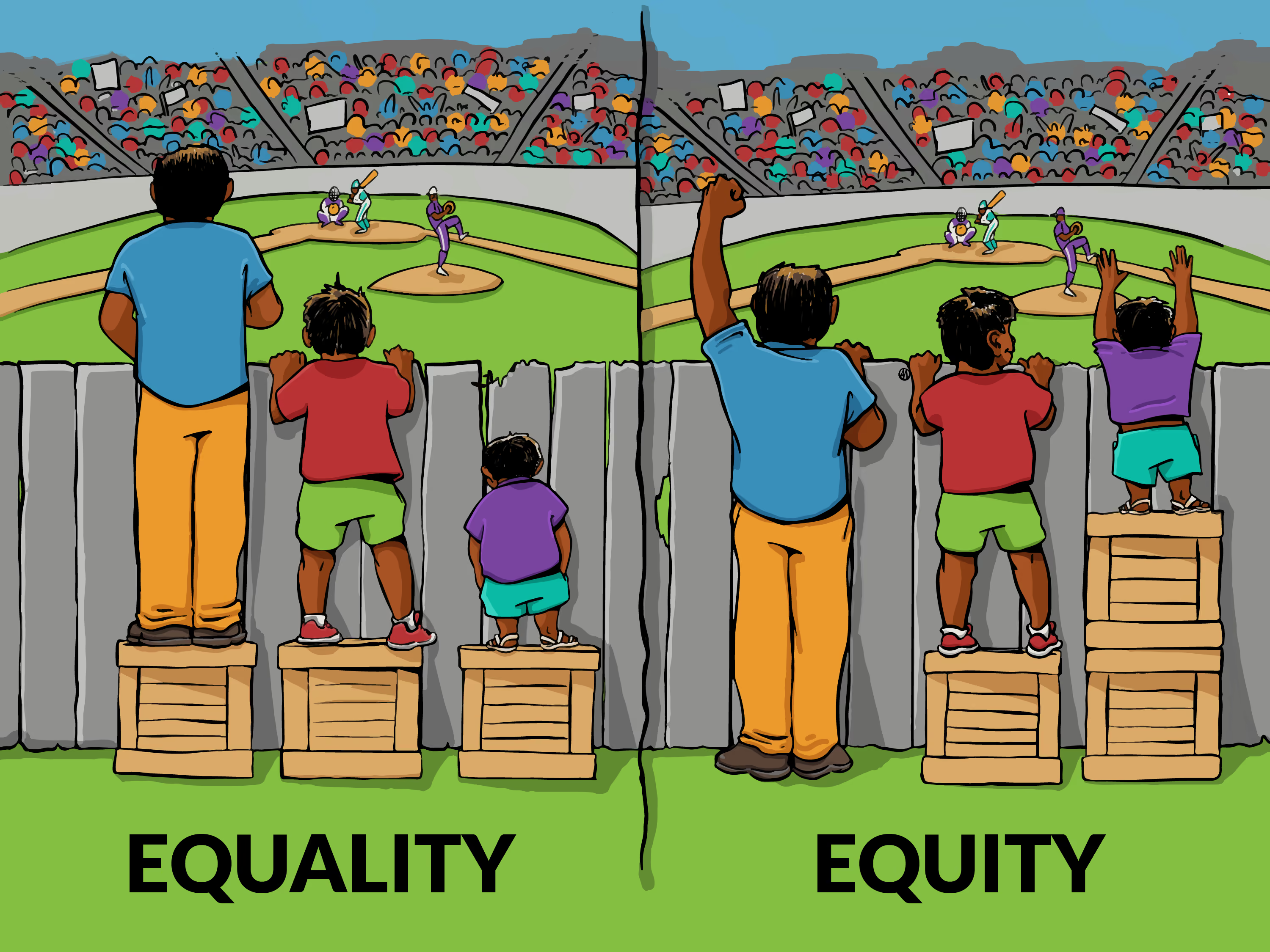
But if you adapt the support to each person's height, everyone can watch the game.
During my education, some teachers understood that. They supported me and helped me succeed. Others treated me badly because they assumed I was lazy.
Two people can have the same rights but face different barriers and have different needs. That's why equity matters. We need to adapt the support, the conditions and the environment so that everyone has a genuine opportunity to succeed.
What I want is for people to have the same chances. Equality, equity and a better understanding of disability. That's what I'd like to see. It would help challenge stereotypes and create a more supportive environment.