Because we're products of a system that excludes certain people, it can be hard to do things differently. Unless we've experienced that exclusion ourselves, or someone has pointed it out to us.
Gradually, this exclusion finds its way into design, and not only through inaccessible interfaces. It also shows up in the data we ask, the people we "forget" to invite to user research, and the way we prioritise our work.
These reflections were the starting point for the talk I gave at Paris Web in September 2025, then in an updated version at MixIT in April 2026 and at Orange's Design pour tous day in July 2026. I talk about ableism and capitalism, and the strange machine that makes us repeat society's flaws through design, no matter how good our intentions.
Ableist society, ableist design?
Before looking for solutions, we need to understand the context we design in.
Before looking for solutions, we need to understand the context we design in.
Accessibility laws have existed in France since 2005. And yet, of more than 7,500 sites checked by France's accessibility observatory, only 0.57% fully comply with the RGAA (the French accessibility standard). That's worrying, to say the least — especially since I know plenty of people who are perfectly competent on the subject.
So if there are plenty of accessibility specialists, why isn't this already sorted? The question had become close to an obsession. You might call it a special interest — but that's beside the point.
Maybe, like me, you've already told yourself that:
- progress on accessibility is painfully slow,
- we'll never get there,
- 100% accessibility is an illusion — because a solution for one person can get in the way of another,
- this must be the fourteenth time you've reported a heading-level issue since last Friday,
- it's the fault of capitalism, which puts money before people.
I tell myself all of these, all the time. With nothing ever moving, I sometimes wonder whether my subject is accessibility or climate change. Either way, it's an inconvenient truth.
That said, I'm not here to tell you it's hopeless — accessibility, I mean. On climate change, I won't commit. I'd like you to finish this article with a bit of hope, rather than a sudden urge to leave tech and go herd goats in the countryside.
The idea, first, is to work out whether an ableist society inevitably produces ableist design. How does this system affect designers, and the experiences of the people who use our services? And, above all, what can we do about it?
To illustrate the point, I'll sketch a flowchart as we go, so you can picture the systemic impact of ableism on the things we design. We'll look at:
- the systems and ideologies that shape us,
- how they show up,
- where they apply,
- and, most importantly, the levers for change that are within our reach.
This article doesn't aim to answer every question in such a vast subject. But I hope it helps you start thinking about it, or take that thinking further.
Before that, though, let's start with a bit of vocabulary.
Definitions
What is ableism?
Ableism is prioritising non-disabled people over Disabled people. If you're Disabled, you're expected to adapt to a system designed by and for non-disabled people — even when that system works against you. You might, for example, be asked to come into the office as often as everyone else, in the name of "fighting your exclusion". It's kind to look after people's needs, of course, but it's better still when the solution comes from people who have those needs.
That said, I know several Disabled people who are tired of the conversations around ableism. They'd rather focus on the lack of accessibility. But to me, the two are linked.
The lack of accessibility is a symptom of ableism, just as street harassment is a symptom of patriarchy — an oppressive system that dominates women. Ableism is an oppressive system too, but one aimed at Disabled people. A system that would like a world where disability doesn't exist.
Internalised ableism
This system of oppression is all the more powerful because it seeps in everywhere, right down to how Disabled people see themselves. And to explain it, I'll give you a very serious source.
In Ratatouille, Rémy dreams of becoming a great chef. But because he's a rat, he's absorbed the idea that it's not for him. As a result, he hides and holds himself back, even though he's perfectly capable — far more so than Linguini, the intern.

Internalised ableism works the same way. It's when a Disabled person takes on the norms that disadvantage them. It might mean forcing yourself into the office despite the pain, turning down an adjustment for fear of being a nuisance, or playing down your difficulties to seem "like everyone else".
It's that little voice saying: "if I'm struggling, it's my fault, so I have to adapt." In those moments, we reproduce exclusion, but against ourselves. We stop asking for what we need, and we keep up the illusion that the system doesn't have to change.
How the system shapes our reflexes
If we do this, it's because, very young, we take on codes known as systemic norms. They're the invisible rules of a system we belong to. And, very often, these norms reinforce inequality.
Take one example: we value being physically present at work. As a result, people who find it hard to travel, or to concentrate in a crowd, are penalised. But because it's such a strong social expectation, questioning it seems completely absurd. Because it's systemic.
Another example: cutting costs as far as possible — the logic of our capitalist society. We'd like money to fall from the sky, as if it were Christmas every day. This idea goes unquestioned too — because it's systemic.
First hypotheses
When I was trying to understand why accessibility still isn't a given, my first thought was: "does nobody actually care?" .
In reality, what I mostly see are people who feel uncomfortable: hesitating over the vocabulary, avoiding questions for fear of getting it wrong. I also see a lot of people holding back, afraid their experience will be brushed aside. In short, I see a lot of discomfort on both sides. And that's where I start drawing the flowchart.
Ignorance breeds discomfort. When you don't know a subject well, it's normal not to feel at ease. That doesn't make you a bad person.

But this ignorance also breeds inaccessible services. Because if we don't know we're meant to do things a certain way, we simply don't do them.
Debunking accessibility misconceptions
To address that ignorance, I spend a lot of time debunking misconceptions. For example, when someone tells me "our users don't have disabilities", I explain that if you count everyone still waiting for a diagnosis — because getting a medical appointment in this country is close to impossible — the figures are already skewed. And let's not forget that most disabilities aren't written on people's faces.
As a result, we tend to underestimate how many people are affected. In fact, there are up to 18.2 million Disabled people in France. So it's hardly "a minority", as you sometimes hear.
By debunking misconceptions, I think we can improve accessibility indirectly, too.
Defending accessibility together
One day, I was talking to someone who felt the effort wasn't worth it if "only a few people are affected". I gave them my arguments. Later, a colleague who'd been listening told me: "thank goodness you were there — I wanted to say something too, but I didn't know what." She wanted to defend accessibility, but she didn't have the right arguments.
Accessibility: play your cards right
That's when I decided I should share these arguments with anyone who might become an ally, so we can defend accessibility together.
So I turned them into a card game — because nothing unsettles ableism quite like a game of Happy Families. The idea is simple. You draw a "myth" card, for example: "accessible design ruins aesthetics".
Then you look for the matching "argument" cards to debunk it. One of them might say: "several WCAG criteria are simply good UX, like explaining how to correct an input error." Explaining how to get out of a form doesn't ruin anything at all. So no — when done well, accessibility doesn't ruin design, and it doesn't get in anyone's way.
The game currently exists only in French. You can download it for free on my site, or buy the full version on FigJam.
Encouraging effort over perfection
Building that workshop was a way of fixing the information in my mind, until I knew every argument by heart. But I also had to learn to pace my efforts.
People need time to get used to what you're saying. If you're a designer, it's a bit like progressive disclosure, but with people: the point isn't to pour out everything you know in one go, however much the subject fascinates you. Whether people seem ready to listen or not, the rule is the same — go gently.
If you choose your moments and your audience well — whether or not you're an accessibility specialist — you'll avoid slipping into judgement, or the kind of frustration that wears you down. All of that costs you energy. And we need your energy.
I've noticed that this frustration comes up a lot among accessibility specialists, and it always makes me wonder. It's a bit like doctors getting annoyed that people keep falling ill every winter. It makes no sense.
Yes, plenty of people are still discovering accessibility. And yes, it's tiring to re-explain the same things over and over. A bit like having to remind everyone, during Covid, that washing your hands was a good idea. Or reminding people that you don't fill in every alt attribute, and you don't need to write "logo" in it.
It can be surprising to have to repeat things like that. But there will always be people who don't know. And for them, it doesn't matter where they start, as long as they start somewhere.
I believe we need to encourage effort and let go of this idea of perfection. Shaming people for not knowing everything, for not saying everything, for getting a comma wrong — that's not how you grow a community. Honestly, at this stage, it doesn't matter. If people want to take up a subject and make a few mistakes along the way, we'll live.
Perfectionism
And yet this tendency to judge isn't just a matter of profession or personality. It's perfectionism that breeds judgement.
It comes from a deeply capitalist idea: that constant profit and flawless performance will lead to a perfect world. In other words, a world without disability.
Capitalism, ableism and perfectionism are systems that feed off one another.

If you're a perfectionist, it's not simply that you're naturally demanding. You can save that line for a job interview. But nobody grew up dreaming of filling in spreadsheets perfectly. Not even accessibility auditors, believe me.
But we do grow up in a system that teaches us it's better to aim for perfection, on pain of ending up on the edge of the village with the circus folk. To avoid a scene, we're supposed to grasp everything at top speed, without a single spelling mistake, without mentioning our bad back, and without asking anyone to repeat what we didn't catch.
And because that's what's expected of us, we end up expecting it of others. But none of that is realistic. It isn't human.
The utopia of bodies and minds
Behind perfectionism lies a kind of utopia about how resilient our bodies and minds should be.
Much of the world is also structured as though everyone is physically strong, as though all bodies are ideally shaped, as though everyone can walk, hear and see well, as though everyone can work and play at a pace that is not compatible with any kind of illness or pain, as though no one is ever dizzy or incontinent or simply needs to sit or lie down.
— Susan Wendell, Toward a Feminist Theory of Disability (Hypatia, 1989)
That's why I don't believe Disabled people are a separate group. It's about everyone, just on a different timeline. Because, at the very least, ageing has exactly the same thing in store for us. But this argument needs handling with care.
Accessibility is, first and foremost, for Disabled people
When we defend accessibility by saying it helps everyone, we forget the Disabled people it's actually for.
We don't defend accessibility because it'll let us use our laptop on the beach. We defend it for the people who can't do without it, right now — and not only at the beach.
Productivity or productivism

If our system doesn't accept disability or imperfection, it's because it expects each of us to produce, whatever the cost. Not much has changed since Chaplin's Modern Times. We confuse productivity with productivism:
- Productivity means doing better with less, without negative consequences for anyone.
- Productivism means producing more, whatever the cost.
In a productivist world, anything that slows production down is seen as negative. Slowing production to do accessibility? No — because it loses money. The result: we favour speed. We ship before audits, we design without user research, all to tick the boxes faster.
A vicious circle
If I go back to the flowchart, capitalism is still there, driving perfectionism, ableism and productivism. And, in a domino effect, each of these systems and ideologies reinforces the others — in society as much as in our design practice.

On top of all this, there's a lack of shared knowledge — due to the absence of accessibility training — which trickles down into our tools, our public policies, our design choices, and even into the way we judge whether a product is any good.
Examples of ableism
Ableism in society
I could give you a long list of how ableism shows up in society:
- forced institutionalisation,
- inclusive schools with no resources,
- repeated delays in accessibility regulations,
- Disabled people being treated as people to be cared for rather than people with rights,
- and constant pressure to appear 'normal'.
But I’m not here to be a downer so I won’t talk about it. Instead, I’ll point you towards the work of Charlotte Puiseux, especially her latest book co-written with Chiara Kahn, Plutôt vivre.
Ableism in design
Shaped by the society it serves, design also prioritises non-disabled people. We design for them first, then wonder how it'll work for "everyone else".
Because design education isn't accessible to everyone, we design services around the needs we already know. Again, that doesn't make you a bad designer. But it doesn't help us imagine more inclusive services either, because our teams aren't diverse enough.
The Figma Sites case
Let's take a recent example that shows clearly how ableism plays out in our tools. At Config 2025, Figma introduced a new product for publishing designs directly to the web: Figma Sites.
Accessibility specialist Adrian Roselli wrote about it:
Do not publish your designs on the web with Figma Sites … Unless you want to fail all the WCAGs, create litigation risk, close off opportunities in Europe, engage in reputational harm, and oh yeah, throw up barriers to your customers and users.
By running automated checkers over the Config site, Adrian found around 200 WCAG errors on the homepage alone:
- insufficient colour contrast,
- frames with no accessible name,
- images without alternatives, and so on.
Of course, Figma Sites is just a tool. As professionals, we know the limits of our tools; we know how to fix them, work around them, or do without them when we have to.
But you can't tell me it doesn't send a message. That accessibility is optional. That we can do without it.
I'm thinking, of course, of the Disabled people who won't be able to use sites built with Figma Sites. But I'm also thinking of designers who are just starting out, or still studying — designers who believe they can ignore constraints that employers will, in fact, expect them to know. Well, not everywhere, apparently. Unless it's all just a conspiracy cooked up by a French government agency.
I'm also thinking of small businesses that don't have 150 designers to hand. Businesses tempted by the easy route, for want of means or knowledge. For them, I find it a bit dishonest.
But let's stay focused. What I keep coming back to is how a product like Figma Sites could launch just a month before the European Accessibility Act came into force.
I've thought a lot about the designers at Figma. Did no one really ask any questions? Let's assume no one objected — I'm not saying that's the case, I've no idea, I wasn't there. But why would designers who are surely among the best in our industry let this slip through? Is it purely a matter of capitalism? Or a sincere, if naive, wish to make designers self-sufficient in publishing their own work?
Prioritising aesthetics over usability
This whole affair got me thinking about the different kinds of designers out there, and about what we count as good design.
In the design world there are, of course, UX designers — often with backgrounds in psychology or marketing. There are also people who come from graphic design or art direction, and even slightly lost souls like me, who arrived from film.
Each of these people works from their own experience, values and idea of what makes good design. For some, it's first and foremost a beautiful design — "the pretty-pretty", as one of my designer friends calls it.
There's nothing wrong with making beautiful things — quite the opposite. But let me offer a small comparison.
When you choose a sofa for your living room, you take your needs into account. If you have no dog, no children and no tendency to knock things over, you can treat yourself to a beige, non-removable-cover, corduroy sofa. A beautiful sofa, in other words.
But if, like me, you live with a husky and his beagle sidekick who love a good wrestle on the sofa, you'll need to adjust your criteria.
I need a sofa that's easy to clean and won't collapse the moment they come charging onto it. Because that's real life — maybe not yours, if you've kept a bit of common sense, but it's certainly mine. We choose according to our real needs, not just how something looks. Even as designers.

When we design digital services, it's the same. Let's keep the three U's in mind:
- useful,
- used,
- usable.
Especially when we're designing a journey to book a medical appointment or order food. Unless you think Disabled people don't go to the doctor or don't eat. You never know — there are so many misconceptions to debunk. I'm not judging.
In short, when you're doing your shopping, Disabled or not, no one cares about the "wow" effect.
The Awwwards case
That "wow" effect always makes me think of the Awwwards. It's a site that rewards designers and developers.
The nominated sites are always very beautiful, but how are they judged? Their scoring system has four criteria:
- Design: 40%
- Usability: 30%
- Creativity: 20%
- Content: 10%
As a UX designer, these criteria make no sense to me. If design isn't usability, is it considered art direction? Apparently not, since there's also a creativity score. And if content isn't design, then what is design?
I also notice there's no mention of accessibility in the criteria. Let alone eco-design. Is it tucked inside usability? No idea. The only accessibility guidance I found on the Awwwards site was in a Google Doc of guidelines for developers. Good luck to the dev teams — apparently it all rests on you.
So I decided to run some checkers of my own over the three most recent nominated sites. The result:
- the first one didn’t load,
- the second wouldn't let me inspect the code,
- the third had 171 contrast errors on the homepage.
As the auditor Sonia Prevost so nicely puts it: "always surprised, never disappointed!" On usability, it's a write-off. And it's then hard to understand what's being rewarded.
Once again, I think about the message we send designers. Don't lose sight of the point. Design is for users. It's not there to impress other designers. And that goes for your portfolio too.
But I'm not telling you this to point at imperfection. As I said earlier, that approach is counterproductive. On the contrary — I think there's an opportunity here: to show that beautiful design can also be accessible.
An opportunity to seize
Imagine what it would be like if, instead of each working in our own corner with our own visions of design, we collaborated. If art and design complemented each other, it could have a positive influence on our industry, on users, and so on our community.
I recently learnt that to value a work of art, you look at all sorts of things — including its provenance. That is, the context it was created in, its history, the people who took an interest in it, who owned it. In short: whose lives the work has touched.

In the series Dickinson, Emily is convinced her poems can be useful in the middle of the American Civil War. Not by stopping the war, but by helping people through it. Perhaps that's another way to measure the worth of a work: by what it brings to the people who encounter it.
Since I learnt that, I've thought it wouldn't hurt to look at design the same way — paying attention to the lives it touches and what it really brings them, at a given moment.
From there, we can ask how much resistance we might put up through the work we do.
AI won't transform your teams for you
Speaking of quick and seductive shortcuts, this brings to mind the dozens of offers I've had in recent months to audit accessibility with artificial intelligence. The pitch is always the same: "no need to bother yourself", "it'll be quicker".
I've been RGAA-certified in auditing since 2025. But since it isn't my core job, I don't offer audits. I understand them better now, but I don't consider myself experienced enough to audit a full service, especially heavy applications.
Now imagine offering an AI tool to audit accessibility to someone with no training at all. How is that person supposed to know whether what the AI tells them is reliable?
And even if it were faster, and even if we could tell whether it was reliable — you can detect all the errors you like, but if teams don't have time to fix them, it changes nothing at all. Transforming a team isn't something you delegate to an AI.
Magic belongs in the cinema, not in accessibility. Trust your specialists instead.
What can we do? Practical actions
Now that the scene is set, let's turn to the levers for change that are within our reach. What can we do without feeling as though we're forever chasing an impossible quest?
Ask more questions
The first thing you can do is ask more questions. A good starting point that costs you nothing.
When I joined MAIF, a lot was already being done on accessibility: a design system gradually being made accessible, training, documentation, and so on. But I didn't become the accessibility lead straight away. I wasn't immediately allowed to run down the corridors shouting "down with ableism!" The way you carry yourself is crucial.
To get there, for a very long time all I did was ask questions. I wanted to understand how things worked, and why, before forming an opinion. Radical, I know.
For example, rather than telling a designer "I hope you annotated your heading levels properly", I ask "how do developers know which heading level to use?" And I try not to blurt out straight away that the TitleTagName goes in Figma's Hidden Props.
You have to give people the chance to suggest a solution that isn't the one you had in mind. What matters is that it works.
And if the person you're talking to hasn't considered the subject, there's less risk of putting their back up — because you didn't approach them assuming they'd done their job badly. You let them realise there's something to do, without accusation. That really matters.
Accept temporary answers
People need time to digest new ideas, especially when it comes to unlearning ableism.
If you tell your colleagues "let's meet for breakfast tomorrow and we'll all have unlearned our ableism overnight", you're likely to be disappointed.
Unlearning systemic norms is a bit like swearing you won't turn into your parents as you age. Hard. But the answers people give you in the meantime are valuable. Treat them as data.
I accept that people give me a temporary answer, because it tells me where we're at and what I need to work on as the accessibility lead.
By talking regularly, wherever someone is in their thinking, I can plant new ideas without forcing anyone to change. And after a while, people can genuinely surprise you.
For example, when I first asked at MAIF whether we could do research with Disabled people, I was told it was illegal to ask people about their health.
First of all, that's not true. You can ask those questions if you can justify the approach (this kind of personal information is more sensitive in France than in the United States, for example). But in reality, you don't even need to. You can use the Washington Group questions, which focus on how people use things rather than on their medical records. So you'd look to recruit people who use a screen reader or a braille display, rather than "blind people" as a category. What you can't do is keep a list of people with their name and disability next to it.
Once again, it's by debunking misconceptions that temporary answers can evolve.
Like my manager, who ended up telling me "of course we can do research with Disabled people", as if he'd always been convinced. But never mind. What matters is that things move forward.
Do inclusive research
Research with Disabled people is essential — if only on democratic principle: there's no reason to exclude Disabled people from our panels. For the method, I'd recommend reading my interview with Gwenaëlle Brochoire.
But if your organisation isn't there yet, you can still act on a smaller scale.
Desk research
You can do desk research, for example through interviews. That might mean reading testimonials, or talking with the people concerned.
For about eighteen months now, I've been interviewing Disabled people about how they use digital tools, to understand how they use the web and where their difficulties lie.
They're conversations that challenge me, and I learn a great deal. But they don't replace user research.
User tests with Disabled people
As a UX designer, I can only encourage you to run real tests with Disabled people — and, ideally, people who don't work with you.
We don't recruit people who work in tech to give their opinion on digital services, because there'd be too much bias. So there's no reason for that to be an acceptable protocol when it comes to accessibility.
And that's precisely the limit of my own interviews. I've mostly spoken with digital professionals.
I realised this when I spoke with Charlotte Puiseux — a researcher, doctor of philosophy and psychologist. She also wrote the book De chair et de fer, about what it means to live in an ableist society as a Disabled woman. Interviewing her, I learnt things I'm not used to hearing — not least because Charlotte doesn't have the workarounds that we, as web professionals, rely on.
So for Charlotte, there's far more giving up. She told me, for instance, how she keeps away from social media:
I feel like it’s an intrusion, as if people might come into my home when I post something. It scares me because I don’t know who will see what I share.
She knows that, in theory, she could set who sees her posts, but she doesn't know how. Charlotte also told me about her exhaustion with the violence online — a violence she already knows all too well in the real world. In the street, people constantly ask whether she's ill and why, as if her Disabled body belonged to everyone. And it's the same online. Strangers ask deeply personal questions, the kind no one would ever ask someone with an invisible disability.
All of this feeds into why Charlotte keeps her distance.
That interview really struck me, because I realised we can't afford to wait for 100% compliance before we take an interest in ableism in design.
Adopt an anti-ableist stance
If people don't feel safe using our services, compliance won't change their exclusion. We have to tackle both things at once.
Full accessibility would be both compliant and anti-ableist — that is, free of misplaced curiosity and stigmatisation.
Take an event registration form. It's not enough to say "if you need anything special, write to us." And, obviously, the form itself needs to comply with the RGAA. One doesn't replace the other.
Don't make people write in to find out whether there'll be stairs, Wi-Fi or power in the building. That's exactly what Audrey Melotti and I talked about, in our conversation on normalising disability.
You can offer clear options up front:
- sign language interpretation,
- a quiet space,
- captioning, and so on.
Normalise the needs of Disabled people
We need to normalise people's needs, including those of Disabled people. These aren't "special" needs, just human needs. Everyone has needs, you included. To read this article, you're not upside down with your feet in the air. That would be quite something. You've taken your needs into account. Human needs. Normalised needs.
I also dream of a world where the effort doesn't only go towards potential customers, but internally too. I'd love for us to include the people concerned in our design teams.
Recently, I interviewed Clémentine Zill, a young visually impaired woman. She told me something that moved me a great deal: "I'd have loved to be a designer, but the tools aren't made for me — I'm inevitably shut out." I won't even dwell on how democratically absurd that is. But I imagine that if Clémentine were on my team, we'd also make fewer accessibility mistakes.
The question isn't so much what we can do for people, but with them. As a movement, and as a community. Because a community should be diverse.
Step outside your echo chamber
Which brings me to echo chambers, those places where we all think the same way.
When I talk about accessibility at accessibility events, most people in the room are already convinced it matters. I'll know we've made progress the day I'm invited to conferences where not everyone is convinced yet — where not everyone is already on board. And perhaps I'll learn things there too. It works both ways. That's why it's so important to step outside your echo chamber.
AccessibilityOps: a strategic approach to accessibility
AccessibilityOps works like DevOps or DesignOps, but for accessibility: a way of connecting people, tools and processes around accessibility. It's exactly what I do at MAIF (a French insurance company).
In practice, at the Digital Factory, we use Jira. And in that Jira, I can see which errors come up in our continuous audits — because I'm lucky enough to have continuous audits at every release. That lets me look at how often errors occur and prioritise my efforts.
If my number one error is heading levels, say, that can feed my backlog. I obviously cross-reference this with how hard the issue is to fix and its impact on users. Once I've identified a problem, I can try to understand where it comes from, and act at the source so it doesn't happen again at scale.
But what's interesting about AccessibilityOps is that we talk about accessibility at every stage of production. It lets us pass reflexes on to teams:
- learning how to learn,
- knowing how to find information,
- normalising disability,
- giving visibility to the people concerned.
Understand how exclusion works
So what next? All this can look wonderful on paper. But in the end, it's your colleagues who'll decide whether or not to do accessibility, and how. Expecting people to do this work consistently, and well, will depend on how well they understand ableism. That's what Devon Persing writes about in The Accessibility Operations Guidebook.
It's only once we've understood the mechanisms of exclusion that we can undo them. Otherwise, even meaning well, we can get it badly wrong — for instance, chasing compliance at all costs before talking to real people. As we've seen, that isn't necessarily a good idea.
Aim for improvement, not perfection
As Meryl Evans says, we can improve in zigzags, in big leaps, or very slowly. It doesn't matter — it's still improvement. It can feel discouraging, but don't confuse the illusion produced by a perfectionist system with what really comes down to your own performance.
In this system, we behave like consumer products on a shelf. We're supposed to be beautiful, strong, competent, likeable, healthy, well-groomed and — above all — free of dog hair on the sofa.
What's striking is that if you talk to the people around you, it isn't perfection that moves them. Quite the opposite: they're moved when they're allowed not to be perfect. Because it's rare. And because it's fair.
Imperfection and vulnerability are, after all, human. And I think Disabled people have things to teach us about that. If we don't take an interest, we can't normalise pain, slowness or even alternatives. Because being Disabled isn't necessarily negative. It isn't necessarily less.
To be blind is to see differently. It is not to remove the word ‘see’ from one’s vocabulary.
Thank you to Sylvie Duchateau for teaching me that.
What kind of design do we want to defend?
Everything I've written above ends up in our products and our services. So I'll leave you with this question: what kind of design do you want to defend?
Make design an act of rebellion
Your work can, and should, be an act of rebellion against bad design.
Mike Monteiro's Ruined by Design was one of the first books I read when I was training as a designer — which probably fed my thirst for justice.
I also went to look up the definition of design in the Larousse dictionary, which defines it as a discipline aimed at harmonising the human environment. So I set off in search of an example of harmonising design.
The Peace Bench
I came across it in Oslo, Norway. It’s the Peace Bench, which Nelson Mandela described as the best weapon for peace.
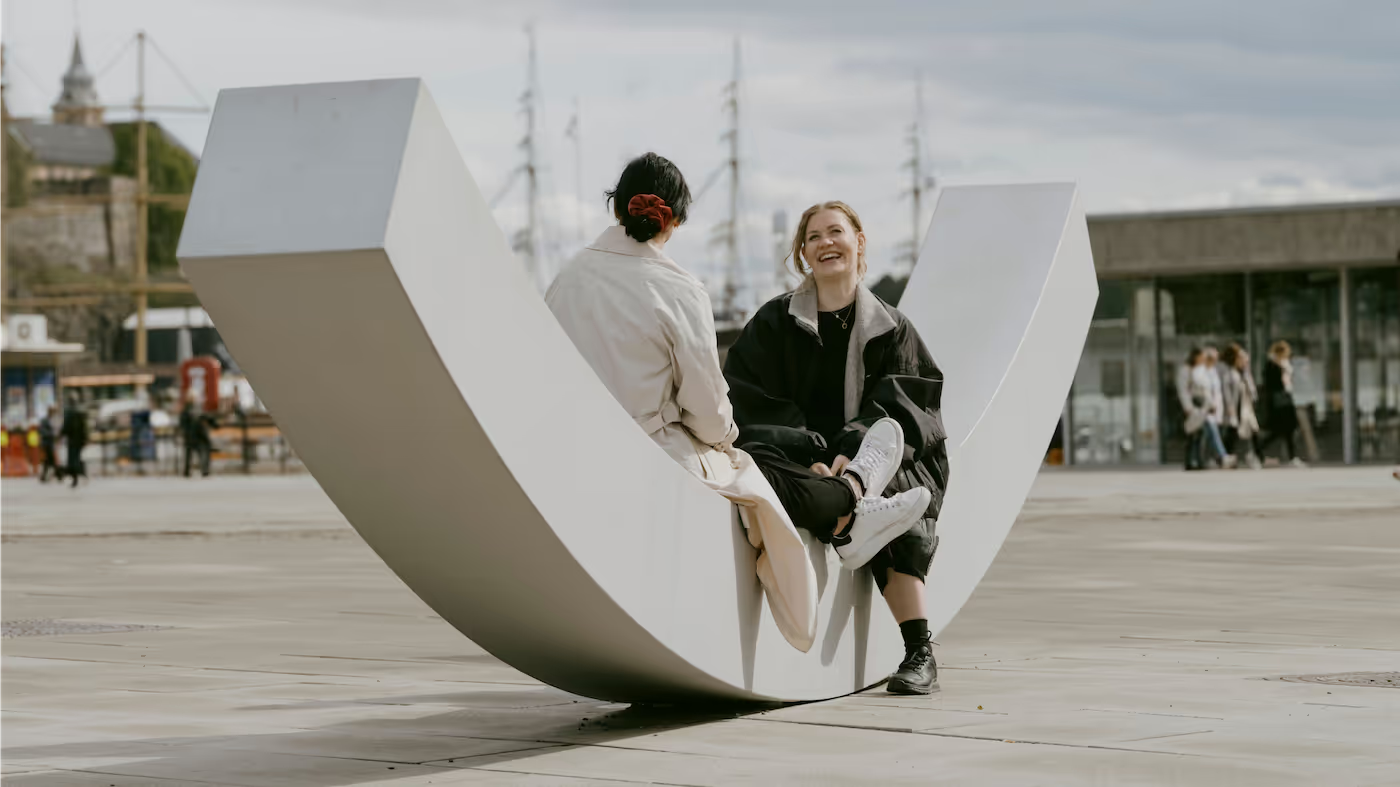
It's a semicircle of aluminium, shaped so that you can't sit on it without sliding towards the person beside you. A weapon that simply lets you sit and talk.
Fellow designers, I'll leave it to you to create a digital version — an accessible one, of course.
Change the end of the story
Design can be a lever for transforming our systems, even on a small scale. And I'd like to end with the words of C. S. Lewis, who wrote:
You can’t go back and change the beginning, but you can start where you are and change the ending.
Accessibility is just one of many fights for a fairer world. Let's be the ones to change how the story ends.
The flowchart to challenge systemic norms in design

The map is divided into four main sections:
- Manifestations of ableist design:
- Ignorance encourages discomfort and inaccessibility,
- Judgement and ignorance reinforce each other.
- Systems and ideologies:
- Capitalism, perfectionism, productivism, and ableism fuel each other.
- Where they apply:
- Capitalism influences art and design.
- Art and design complement each other, but they are not the same.
- Design and community strengthen each other.
- Tools for anti-ableist stance:
- Methodology:
- Do inclusive research,
- Challenge mental models with Design Fiction,
- Connect people, tools and processes with AccessibilityOps.
- Collective strategies:
- Debunk misconceptions,
- Encourage effort over perfection,
- Pace yourself.
- Individual strategies:
- Progress over perfection,
- Ask more questions,
- Accept temporary answers,
- Step outside your echo chamber.
- Methodology:
These levers help dismantle inaccessibility and ignorance, while strengthening design and community.